
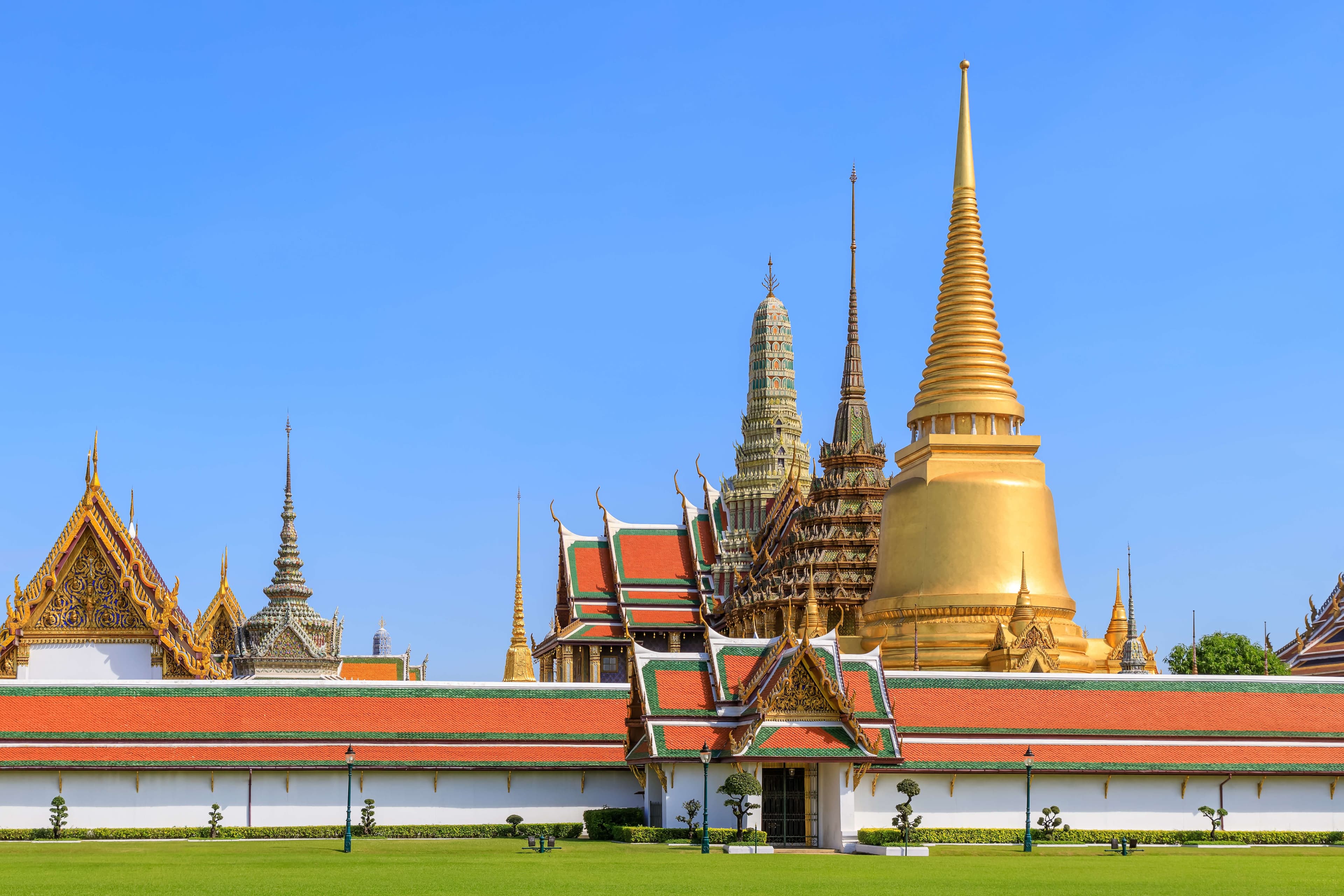

Morning light over the Chao Phraya River begins to spill quietly across the Grand Palace’s white walls. The gold of the prangs catches the first light of day as if it were not merely decoration, but a declaration of the presence of something larger than the buildings themselves.
People gradually move into the same space. Some come for faith, some to learn, and some simply because this is something they feel they must see at least once in their lives. But once they step through the gates, many visitors begin to feel something shift without quite realizing it.
This place does not function like a tourist attraction. It functions like a structure of meaning.
What the Grand Palace Means in the Context of History and the State
The Grand Palace was never built simply as a royal residence. It was designed to be the center of an entire system, bringing together power, religion, and state ritual in an inseparable way.
Every architectural element serves not only beauty, but also the purpose of making power visible. The walls do more than enclose space; they define the boundaries of meaning.
The Grand Palace is not a backdrop to history; it is the mechanism that makes history possible.
Why Power Was Designed to Be Visible
In this system, power is not expressed through commands alone. It is designed to be seen through architecture, through ritual, and through the arrangement of space. Every building has a role, every area has a hierarchy, and every route carries a predetermined meaning.
This is not a city that emerged naturally. It is a city designed so that meaning could function.
Ritual and the Legitimacy of the State
What sets the Grand Palace apart from royal architecture in many countries is not only its beauty, but the way it sustains power through ritual. The ceremonies held within this space are not merely religious symbols; they are mechanisms that connect the state, faith, and legitimacy.
In this system, ritual is not an accessory to power. It is power’s very form.
The Grand Palace as the State’s Cosmology
If we look beyond architecture, the Grand Palace is not just the arrangement of buildings within a space. It is the ordering of the world. Every element reflects the idea that the physical world and the spiritual world are never truly separate.
So every line of the palace is not only about architecture, but about the state’s cosmology.
Made visible through form, space, and architectural hierarchy
Connected to sacredness and the meaning of place
Functions as the mechanism that sustains power and legitimacy
What to Notice When Visiting the Grand Palace
What most visitors see may be the beauty of gold, patterns, and intricate details. But what lies deeper is the system that allows meaning to keep working continuously. The Grand Palace is therefore not something to be looked at just once and left at that.
It is something that should be read again and again at different levels of understanding.
Why This Place Helps Explain Thailand
The Grand Palace is not only a symbol of the past. It is a structure that helps explain the Thai state’s way of thinking: a state that does not separate power from faith, and does not separate faith from ritual, but turns all three into a single system.
And from that system, the meaning of Thailand has been continuously formed—not only in the past, but still in the present.
As sunlight moves across the prangs once more, the Grand Palace remains in the same place—quiet, steady, and unchanged at first glance. But as time passes, many visitors begin to understand something different.
This is not just an important place. It is a system still at work in the form of meaning. And when you leave, what remains is not a photograph, but a question: are we really looking at a place, or are we looking at the way a nation is made?