
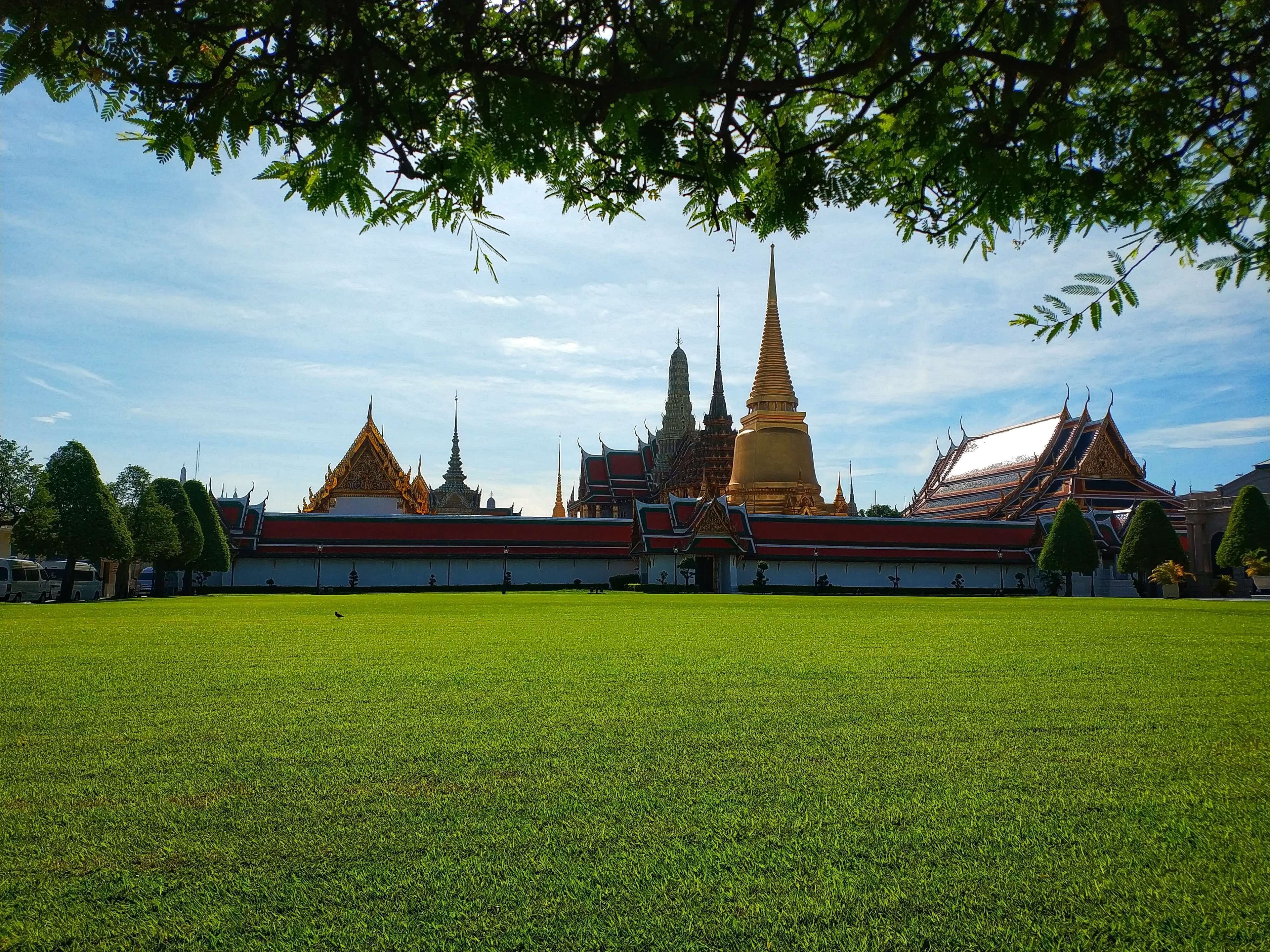

Morning light over Rattanakosin Island slowly spills down the roofs of the Grand Palace before touching the broad open ground ahead: Sanam Luang. At first glance, it seems little different from a vast empty square in the middle of the city, yet that emptiness holds something within it.
As soon as the city begins to move, Sanam Luang quietly changes its rhythm. Travelers pass through as if it were a connecting route. Bangkok residents use it as part of their daily lives. Children run beneath the shade of tamarind trees, and some people simply pause for a moment, unaware that they are standing in a place at the center of meaning.
The Empty Ground That Asks Questions
Sanam Luang does not tell its story through what has been built, but through what has been left open. This broad space in front of the Grand Palace was not created by chance; it was part of the original design of Rattanakosin from the very founding of the capital.
If the Grand Palace is the center of power and Wat Phra Si Rattana Satsadaram is the center of faith, Sanam Luang is the space where both open outward to the people. It is therefore not merely an open square, but a place that connects the state with everyday life.
From Ceremony to Everyday Life
In the early days of Rattanakosin, Sanam Luang played an important role in royal ceremonies of the kingdom—rituals tied to fertility, stability, and the relationship between the monarch and the people. What mattered in those ceremonies was not only the ritual itself, but the opening of space for people to take part.
Over time, Sanam Luang’s role did not stop at ceremony. It has been a venue for performances, a temporary market, a gathering place during important moments in the nation’s history, and a part of everyday life in the capital. What is remarkable is that no matter how its role has changed, Sanam Luang has never stopped functioning.
Shared Memory Among the People
Sanam Luang has never been merely a backdrop for important events; it is a place where people become part of those events. Farmers once traveled here to join ceremonies with hope. A child once sat on a father’s shoulders to see a royal procession for the first time in life. And people from the provinces once stood at the edge of the square to witness a defining moment in the nation’s history.
Sanam Luang does not remember only events; it remembers the shared presence of people.
In many periods, Sanam Luang has therefore served as more than a place. It has become a shared memory.
A Place That Changes with Time
When the ceremony ends, the city returns to its usual rhythm. Sanam Luang becomes quiet again, but not with the silence of emptiness. It is the silence of a place waiting for its next use.
A new morning begins as before. Bangkok residents walk through on their way to work. Students sit and rest here. Travelers pause to look at the skyline of the old city. Families bring children to experience a place that was once part of history. Ordinary life does not replace ritual; it lives alongside it.
The Ground Where the Nation Breathes Together
Seen from afar, Sanam Luang is not just a broad open space between the Grand Palace and the city. It is a place that reveals the relationship of the country as a whole. Here, the sacred is not kept behind gates. Ritual does not happen far from public view, and the meaning of the state is not confined to documents or buildings.
Sanam Luang is therefore not only a public space, but a place that turns the word nation into a shared experience—not because everyone thinks alike, but because everyone has stood in the same place at moments when something meaningful was experienced together.
The Ground That Never Stops Remembering
As evening light falls gently across the grass again, the shadows of the tamarind trees lengthen over the ground. People gradually leave in different directions. Children keep running, travelers keep taking photos, and ordinary life continues. Everything seems simple, as if nothing had happened.
But beneath that simplicity, Sanam Luang continues to hold every moment within itself: ritual, memory, silence, and everyday life. In the end, a nation exists not only because of what has been built, but because of what people share and remember together.
When you step beyond Sanam Luang, the journey does not end. It simply changes rhythm. From this open ground that connects the state and the people, we move into Rattanakosin Island, where the city’s details begin to reveal themselves more clearly, and the relationship between palace, temple, community, and daily life appears at a closer range than before.