
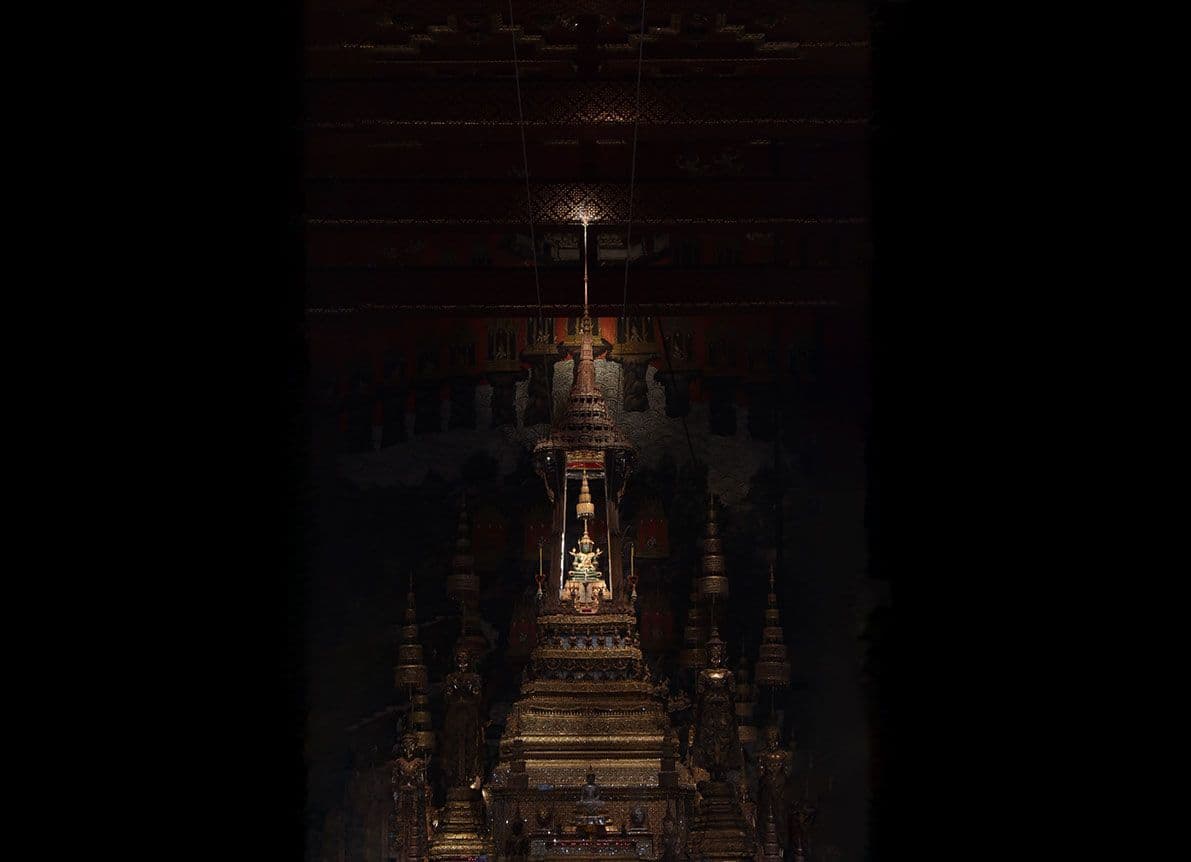

Every visitor to Bangkok’s Grand Palace makes their way to the ubosot of Wat Phra Kaew, yet many leave without grasping the full weight of what they have seen.
The Emerald Buddha is not just a statue; it is a survivor of centuries of warfare, a silent witness to the rise and fall of kingdoms, and the spiritual anchor of the Thai monarchy.
It’s Not Actually Made of Emerald
Despite the moniker, historians and geologists generally agree that the statue is not carved from emerald. Instead, it is likely crafted from fine green jade or jasper.
The name 'Emerald Buddha' refers more to its radiant, distinctively green appearance—a color synonymous with divine status—than to its mineral composition.
Surprisingly Small in Scale
First-time visitors are often taken aback by its size. Expecting a colossus, they find instead a delicate figure standing approximately 66 centimeters tall.
Its power lies not in physical magnitude, but in its immense spiritual and historical gravity; it is a case where size truly does not dictate significance.
The Emerald Buddha's prestige grew through the ages, not by the height of its pedestal, but by the weight of the kingdoms that pledged their loyalty to it.
A Long Journey Across Kingdoms
The history of the Emerald Buddha reads like a grand epic. Before settling in its permanent home in Bangkok, it traveled through a constellation of regional powers.
From Chiang Rai and Chiang Mai to Luang Prabang and Vientiane, the statue’s movements were often tied to the shifting borders and fortunes of the Tai-Lao kingdoms.
The Legend of the Plaster Shell
According to popular legend, the statue was unearthed in Chiang Rai in 1434 after a lightning bolt shattered an ancient chedi.
Among the rubble sat a stucco-covered image. When the plaster peeled away, the brilliant green stone beneath was revealed. Whether myth or historical fact, it remains one of the most cherished origin stories in Thai culture.
An intimate scale that belies its immense spiritual power.
The statue undergoes a royal ritual change of attire three times a year.
A survivor that has resided in multiple historic kingdoms across Southeast Asia.
A Link to Wat Arun
Before the Grand Palace was even a blueprint, the Emerald Buddha resided in Thonburi during the reign of King Taksin. It was kept in the vicinity of Wat Arun—the Temple of Dawn.
When King Rama I founded the new capital of Bangkok, he moved the icon across the Chao Phraya River, permanently intertwining the fates of the two temples.
The King’s Seasonal Ritual
Three times a year, the monarch of Thailand leads a ceremony to change the Emerald Buddha’s vestments. These elaborate costumes correspond to the summer, rainy, and cool seasons.
This tradition is more than just ornamentation; it is a sacred duty that highlights the King’s role as the protector of the nation and the seasons.
A Symbol of Political Legitimacy
For centuries, the Emerald Buddha was regarded as the palladium of the state. Its presence was seen as a prerequisite for ruling.
To possess the Emerald Buddha was to hold the spiritual mandate to govern, making its arrival in Bangkok the ultimate confirmation of the city's status as a true, eternal capital.
Why It Still Commands Such Awe
While modern Bangkok races toward the future, the Emerald Buddha remains fixed in time.
It is the sheer density of history, legend, and royal devotion packed into such a small frame that keeps visitors coming back. Even the briefest glimpse provides a profound connection to the heart of Thai civilization.
Location
Wat Phra Kaew
Address
Na Phra Lan Road, Phra Borom Maha Ratchawang, Phra Nakhon, Bangkok 10200
Hours
Daily 8:30 AM - 3:30 PM
Website
The Grand Palace