
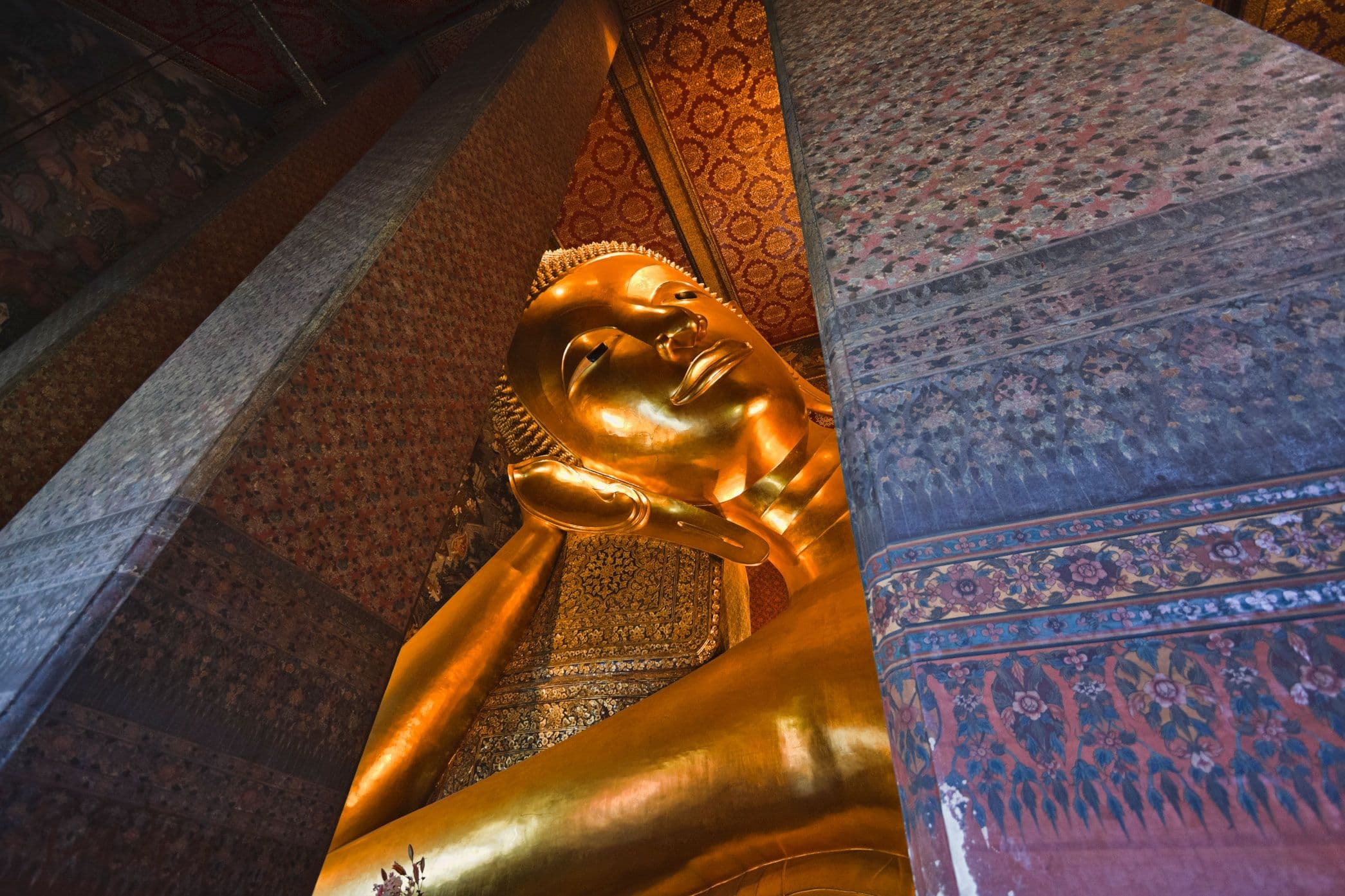

Every visitor stepping into the hall of the Reclining Buddha at Wat Pho is struck by the same thought: How is it so massive?
The statue seems to dwarf the very building housing it. Its head towers over onlookers, while the body stretches so far that capturing it in a single frame is a challenge for any photographer.
Yet, this immense scale wasn't merely a display of power. Every inch of the statue was meticulously crafted to lift the visitor out of the everyday and into a space of profound spiritual significance.
More Than Just a Resting Figure
It’s a common misconception that the Buddha is simply taking a nap. In reality, this pose depicts the Buddha’s final transition into parinirvana—the ultimate release from the cycle of rebirth.
Far from representing rest, the statue embodies spiritual completion, absolute peace, and the transcendence of suffering.
The immense scale was intended to force visitors to physically experience the shift from mundane space to the sacred.
A Masterclass in Scale
Measuring roughly 46 meters in length and 15 meters in height, this is one of Thailand’s most spectacular Reclining Buddhas.
Royal temple architecture in Thailand often utilized sheer scale to inspire reverence. As soon as you enter the hall, your sense of perspective is shattered; you feel small, and that humility is entirely intentional.
A Measured Reveal
The architecture of the hall is intentionally claustrophobic by design.
You cannot stand back and take it all in at once. Instead, you are guided through a narrow corridor where you encounter the face, then the sprawling body, and finally the intricate feet. It is a slow-motion revelation, designed to be experienced as a journey rather than a single glance.
The Sacred Soles
While many eyes are drawn to the serene face, the true masterwork lies at the feet.
The soles are beautifully inlaid with mother-of-pearl, depicting 108 distinct auspicious symbols central to Buddhist cosmology. It serves as a reminder that in Thai art, even the smallest detail holds deep religious gravity.
One of the most imposing Reclining Buddha statues in the Kingdom.
The mother-of-pearl feet are mapped with sacred Buddhist iconography.
A cornerstone of the early Rattanakosin period.
A Symbol of a New Capital
When Bangkok was established as the new capital, Wat Pho was elevated to a royal temple of paramount importance.
Restored and expanded by King Rama I and King Rama III, the temple was a beacon of revival after the fall of Ayutthaya. The colossal Reclining Buddha stood as a testament to the renewed spiritual and political might of the new Siamese capital.
A Center of Wisdom
Beyond its religious function, Wat Pho was the intellectual hub of its time.
It was a sanctuary for traditional Thai medicine, massage therapy, astronomy, and literature. For many, it functioned as Thailand's first true public university, preserving the nation's collective knowledge.
The Rhythmic Ritual
Walk behind the statue, and you will hear a rhythmic, metallic melody: the sound of visitors dropping coins into 108 bronze bowls.
This simple act of merit-making creates a living, ambient soundscape that fills the hall. It turns the visit into a multisensory experience, blending visual grandeur with the echoes of devotion.
Timeless Resonance
Bangkok today is a city of rapid change, dominated by steel and glass. Yet, the Reclining Buddha remains a grounding force. It continues to move people not just because of its size, but because it offers something that feels larger than life itself: a moment of stillness in a bustling world.
Location
Wat Pho Reclining Buddha
Address
2 Sanamchai Road, Grand Palace Subdistrict, Phra Nakhon, Bangkok 10200
Hours
Daily 8:00 AM - 6:30 PM
Website
Wat Pho